

HydroPeptide in Belleza Médica: peptide cosmeceuticals for oncology skin care
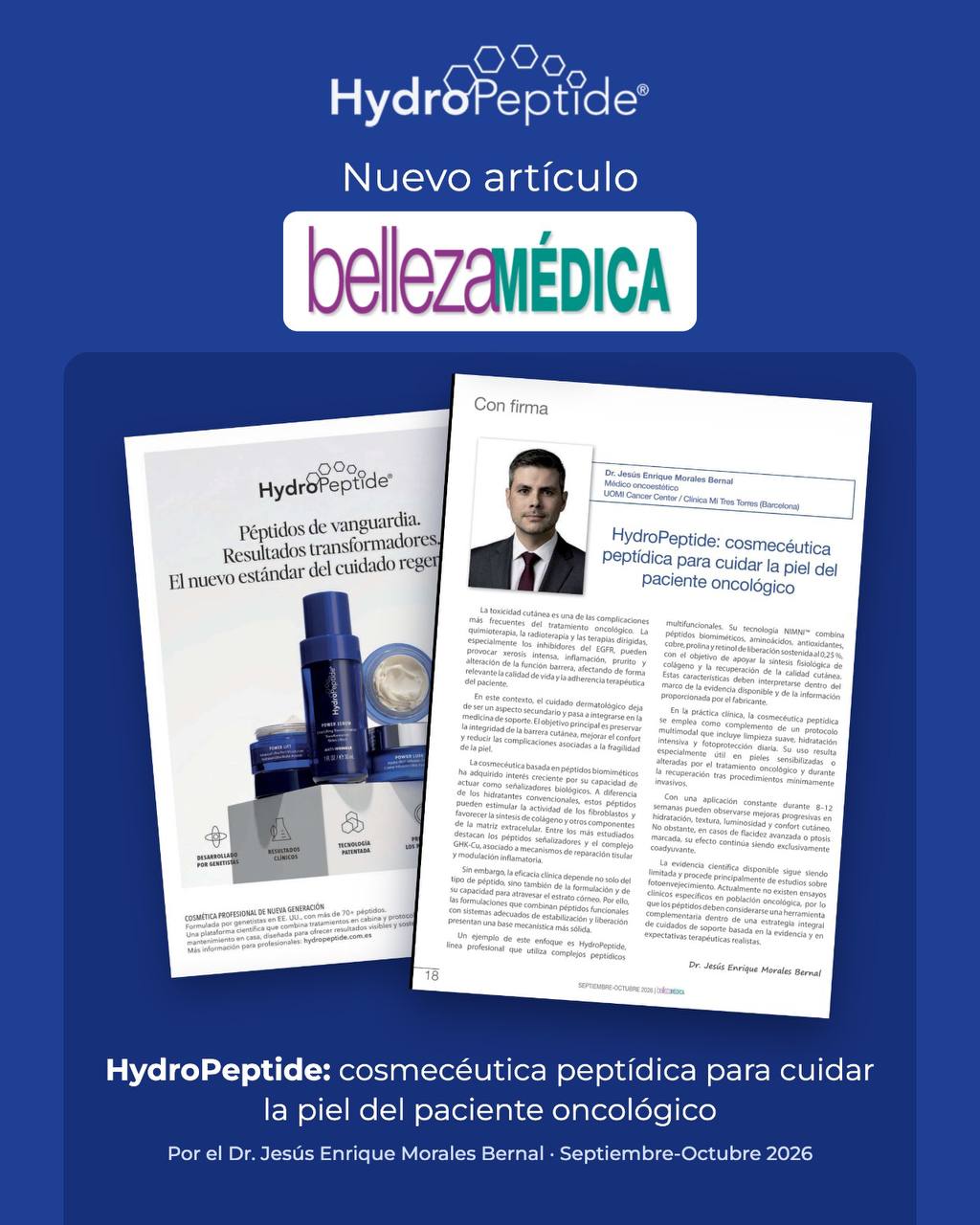
In its September–October issue, Belleza Médica magazine publishes an article by Dr. Jesús Enrique Morales Bernal, onco-aesthetic physician at UOMI Cancer Center / Clínica Mi Tres Torres (Barcelona), on the role of HydroPeptide peptide cosmeceuticals in caring for the skin of oncology patients.
The article explains how biomimetic peptides, combined with an appropriate formulation and a routine of gentle cleansing, intensive hydration and sun protection, can help care for the skin and maintain its barrier function during cancer treatment.
A professional perspective on the importance of skin care as a complementary part of a comprehensive supportive care strategy.
We invite you to read the full article below.
Peptide Cosmeceuticals in the Oncology Patient: Molecular Basis, Clinical Integration and a Critical Reading of the Technology
Narrative review with critical appraisal

Dr. Jesús Enrique Morales Bernal
Onco-aesthetic physician · UOMI Cancer Center / Clínica Mi Tres Torres, Barcelona
Licensed physician · COMB 58763 · ICOMEM 282879779. UOMI Cancer Center / Clínica Mi Tres Torres, Barcelona, Spain. ORCID: 0009-0000-2205-6425.
Abstract
Skin toxicity is one of the most frequent and least well-controlled consequences of cancer treatment, affecting patient comfort, body image and treatment adherence.[12,13] In this context, peptide-based cosmeceuticals have been proposed as adjuvant skin support. This narrative review analyses the molecular basis of the main peptide families —signal, carrier and neurotransmitter-inhibiting peptides—, the formulation challenge posed by the stratum corneum barrier, and the rationale for integrating them into protocols stratified by clinical phase.[1,6] It also reviews the available level of evidence, which places peptides among the best-studied cosmeceuticals for photoaging, albeit with heterogeneous data, largely industry-funded and without controlled trials specifically in oncology skin.[9,11] A critical reading of the HydroPeptide brand and its NIMNI technology is included as an example of a multi-component formulation. We conclude that the clinical value of these tools lies in their prudent use within rigorous supportive medicine, with realistic goals and honest communication of therapeutic limits, and never as a substitute for guideline-backed supportive measures.[12]
Keywords: peptides; cosmeceuticals; supportive care in oncology; skin toxicity; GHK-Cu; skin barrier; matrikines.
Why peptides in oncology
In clinical oncology practice, the skin rarely sits at the centre of the treatment algorithm, yet it often shapes the patient's daily experience, well-being and adherence to treatment. Radiotherapy, chemotherapy and targeted therapies —most characteristically epidermal growth factor receptor (EGFR) inhibitors— can cause severe dryness, fragility, acneiform reactions and impaired barrier function, to the point of requiring dose reduction or treatment interruption.[13] Dermatological support is therefore no longer an accessory but part of comprehensive care; indeed, preventive and structured skin treatment has been shown to reduce the incidence of grade ≥2 toxicity and improve quality of life in patients on anti-EGFR therapy.[13]
The rationale for peptides is that they are not limited to an occlusive or emollient effect but belong to a biological-signalling paradigm. They are short amino-acid sequences able to mimic bioactive fragments of the extracellular matrix —so-called matrikines— or endogenous growth factors, with the potential to modulate fibroblast activity and promote an environment more conducive to tissue repair.[1,2]
The clinical interest of this approach increases when one considers that skin senescence is not merely a passive loss of collagen but an active pro-inflammatory state: the senescence-associated secretory phenotype involves overexpression of matrix metalloproteinases and interleukins that accelerate degradation of the dermal matrix and deterioration of the dermo-epidermal junction.[8] In skin weakened by disease and iatrogenic factors, a strategy with signalling capacity offers a more coherent mechanistic basis than a purely corrective or superficial filling intervention.
Molecular basis: peptide families and mechanism of action
Peptides are not a homogeneous category, as their biological behaviour depends on the family to which they belong. Signal peptides, such as palmitoyl pentapeptide and related derivatives, act as matrikine-type ligands that lead the fibroblast to interpret the presence of matrix damage, promoting the synthesis of collagen, fibronectin and glycosaminoglycans through pathways related to TGF-β and growth factor receptors.[1,2]
Carrier peptides, including the copper tripeptide GHK-Cu, offer a particularly interesting rationale for vulnerable skin: they deliver copper, a key cofactor of lysyl oxidase for collagen cross-linking, and have been linked to modulation of metalloproteinases, angiogenesis and re-epithelialisation.[3,4] Preclinical data also describe anti-inflammatory actions and fibroblast recovery after irradiation, a theoretically attractive profile in the oncology patient, although it comes mostly from experimental models rather than clinical trials in this population.[4]
Neurotransmitter-inhibiting peptides, such as acetyl hexapeptide (argireline), target dynamic expression lines and have some randomised placebo-controlled evidence in periorbital wrinkles; their role is secondary in the oncology setting, where the goal is not expression lines but skin integrity and comfort.[5]
The main challenge remains the stratum corneum barrier, which limits the penetration of hydrophilic, relatively large molecules such as peptides, so that the vehicle, the stability of the active ingredient and the application context determine whether the peptide reaches a biologically useful level or remains confined to the surface.[6] This limitation is central to cautiously interpreting the efficacy claims of any topical peptide formulation.
Protocol-based integration according to clinical phase
Integrating peptides makes most sense when synchronised with tissue biology. In minimally invasive procedures —microneedling, fractional radiofrequency, non-ablative laser or medium-depth peels— controlled barrier disruption opens a window of opportunity to enhance peptide delivery during the repair phase, a phenomenon demonstrated for various cosmeceutical actives.[7] Retinoids and exfoliants, by contrast, are reserved for maintenance phases further away from the procedural stimulus, given that the reference topical with the strongest support in rejuvenation remains tretinoin.[10]
In the oncology patient, however, the strategy must be deliberately conservative: any barrier procedure or irritating active must be subordinated to the condition of the skin, active cancer treatment and evidence-based supportive measures. The priority is not to pursue a maximalist cosmetic result but to restore comfort, tolerability and continuity of skin care.
Application and positioning in the oncology patient
Peptide cosmeceuticals find their place in sensitised, reactive skin or skin whose barrier has been altered by treatment, always as a complement and never as a substitute for the indicated medical treatment or for guideline-backed supportive measures.[12] This point deserves emphasis: clinical practice guidelines for acute radiation dermatitis recommend interventions such as photobiomodulation, certain dressings, topical corticosteroids or olive oil, and do not include peptide cosmeceuticals among the recommended measures; these should therefore be understood as comfort support rather than guideline-endorsed therapy.[12]
Product selection should depend less on the marketing of the “peptides” category and more on the coherence of the formulation, its tolerability and the plausibility of its mechanism. Managing expectations is also essential: in advanced laxity, deep folds or ptosis the role is merely adjuvant, whereas in mild-to-moderate photoaging, sensitive skin and post-procedure support it can provide progressive improvements in texture, hydration, radiance and perceived firmness, usually after eight to twelve weeks of consistent use within a multimodal protocol.[9,10]
Assessment of results and clinical recognition
The most consistent clinical observation is a progressive, cumulative improvement in texture, hydration, radiance and comfort, with softening of fine lines when use is sustained and well integrated into the protocol. To go beyond standardised photography, high-frequency skin ultrasound allows dermal thickness and echogenicity to be estimated and has been used to monitor anti-ageing therapies; however, causal attribution should be interpreted with caution in multimodal settings.[14]
This approach, centred on comprehensive patient support rather than on the product, is in line with the team's track record in oncology care. In 2025 the team received the IASLC recognition as the best European team in supportive care, nominated by the patients themselves —a relevant fact because it reflects the perceived impact of care in a field where the patient experience is part of the clinical outcome. Its value is not promotional; it represents external validation of a care model aimed at accompanying skin toxicity, improving comfort and sustaining adherence from a human, protocol-based perspective.
HydroPeptide and NIMNI technology
From a formulation standpoint, HydroPeptide stands out by working with a broad peptide architecture and by presenting complexes at use-level concentrations, as opposed to formulations that include a single peptide in a way that is more narrative than pharmacologically relevant. Its main declared milestone is NIMNI technology, described by the manufacturer as a proprietary complex of amino acids, sulphur donors and antioxidants designed to act at different levels of the collagen process.
The combination of copper and proline for collagen cross-linking, 0.25% sustained-release retinol for cell turnover and additional biomimetic peptides makes up a broad-spectrum collagen-support proposition that is mechanistically plausible in light of copper's role as a cofactor of lysyl oxidase.[3,4] That said, the claim of technological uniqueness should be interpreted primarily as an intellectual-property position and not as automatic proof of clinical superiority over active comparators. Figures attributed to the brand come from the manufacturer and should be presented as such; the value of the text increases when it maintains a pharmacological and critical reading, acknowledges the plausibility of the mechanism and avoids overstating the strength of the clinical evidence.
Limitations and level of evidence
Within the cosmeceutical universe, peptides are among the actives with the strongest support against photoaging, with studies reaching high levels of evidence in systematic reviews.[9] However, this evidence is heterogeneous, frequently manufacturer-funded, based on surrogate endpoints or self-assessment, and with limited sample sizes; systematic reviews of topical anti-ageing repeatedly point to the scarcity of high-quality, independent data.[11,15] Critically, there are no controlled clinical trials specifically evaluating peptide cosmeceuticals in oncology skin, so any extrapolation to this population is indirect. This review is narrative rather than systematic, which limits its comprehensiveness and makes it susceptible to selection bias. Consequently, the recommendations made here are prudential and supportive in nature and should not replace guideline-endorsed interventions or individualised clinical judgement.[12]
References
- Sirois JP, Heinz A. Matrikines in the skin: origin, effects, and therapeutic potential. Pharmacol Ther. 2024;260:108682. doi:10.1016/j.pharmthera.2024.108682
- Tran KT, Griffith L, Wells A. Extracellular matrix signaling through growth factor receptors during wound healing. Wound Repair Regen. 2004;12(3):262-268. doi:10.1111/j.1067-1927.2004.012302.x
- Pickart L, Margolina A. Regenerative and protective actions of the GHK-Cu peptide in the light of the new gene data. Int J Mol Sci. 2018;19(7):1987. doi:10.3390/ijms19071987
- Pickart L. The human tri-peptide GHK and tissue remodeling. J Biomater Sci Polym Ed. 2008;19(8):969-988. doi:10.1163/156856208784909435
- Wang Y, Wang M, Xiao S, Pan P, Li P, Huo J. The anti-wrinkle efficacy of argireline, a synthetic hexapeptide, in Chinese subjects: a randomized, placebo-controlled study. Am J Clin Dermatol. 2013;14(2):147-153. doi:10.1007/s40257-013-0009-9
- Jiménez-Rodríguez A, Guardado-Félix D, Antunes-Ricardo M. Challenges and strategies for topical and transdermal delivery of bioactive peptides. Crit Rev Ther Drug Carrier Syst. 2022;39(1):1-31. doi:10.1615/CritRevTherDrugCarrierSyst.2021038141
- Shin CI, Kim M, Kim YC. Delivery of niacinamide to the skin using microneedle-like particles. Pharmaceutics. 2019;11(7):326. doi:10.3390/pharmaceutics11070326
- Lee H, Hong Y, Kim M. Structural and functional changes and possible molecular mechanisms in aged skin. Int J Mol Sci. 2021;22(22):12489. doi:10.3390/ijms222212489
- Chan LKW, Lee KWA, Lee CH, et al. Cosmeceuticals in photoaging: a review. Skin Res Technol. 2024;30(9):e13730. doi:10.1111/srt.13730
- Griffiths TW, Watson REB, Langton AK. Skin ageing and topical rejuvenation strategies. Br J Dermatol. 2023;189(Suppl 1):i17-i23. doi:10.1093/bjd/ljad282
- Imhof L, Leuthard D. Topical over-the-counter antiaging agents: an update and systematic review. Dermatology. 2020;237(2):217-229. doi:10.1159/000509296
- Behroozian T, Bonomo P, Patel P, et al. Multinational Association of Supportive Care in Cancer (MASCC) clinical practice guidelines for the prevention and management of acute radiation dermatitis. Lancet Oncol. 2023;24(4):e172-e185. doi:10.1016/S1470-2045(23)00067-0
- Lacouture ME, Mitchell EP, Piperdi B, et al. Skin toxicity evaluation protocol with panitumumab (STEPP): a phase II, open-label, randomized trial. J Clin Oncol. 2010;28(8):1351-1357. doi:10.1200/JCO.2008.21.7828
- Czajkowska J, Juszczyk J, Bugdol MN, et al. High-frequency ultrasound in anti-aging skin therapy monitoring. Sci Rep. 2023;13(1):17799. doi:10.1038/s41598-023-45126-y
- Edison BL, Parsa R, Dufort M, Tierney NK, Green BA, Farris PK. Acetyl dipeptide-31 amide: a novel cosmetic anti-inflammatory peptide. J Drugs Dermatol. 2025;24(1):23-33. doi:10.36849/JDD.8786
Literature search conducted in PubMed (June 2026). References in Vancouver style.


